


Asian Finance Review
Taiwan's stock market has risen above 40,000 points. Why is your account still in the red? Four fundamental logics for safeguarding principal in a bull market
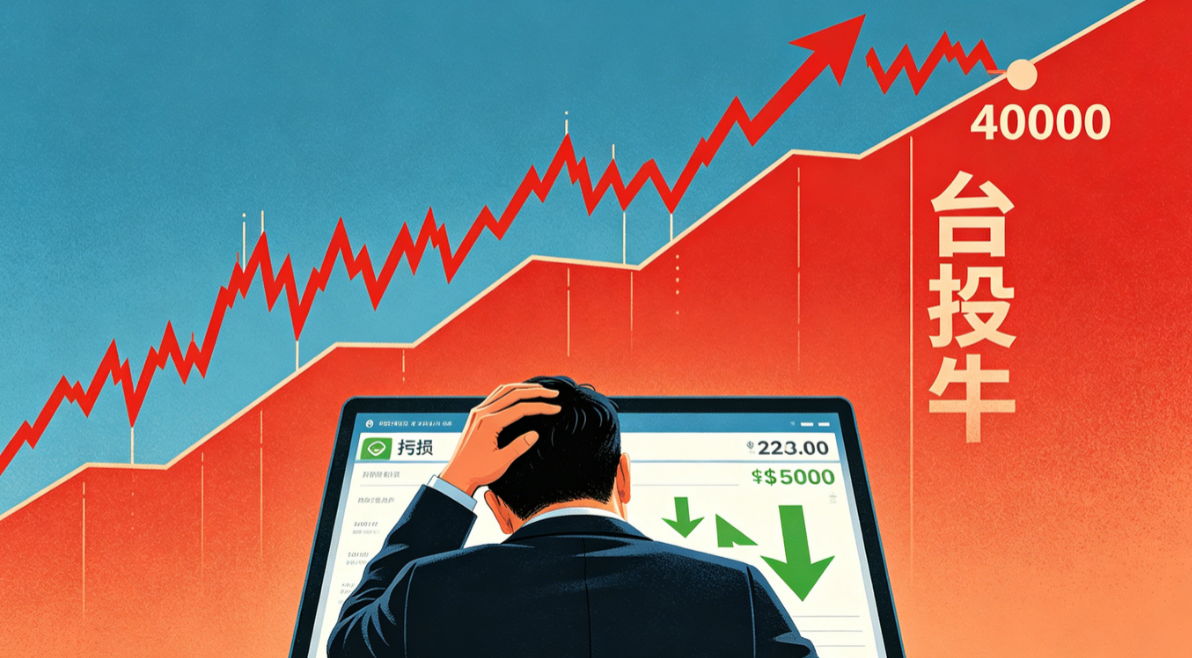
Taiwan's stock market smoothly broke through the 40,000-point mark, with the overall market continuing to set new highs. However, many individual investors' accounts are still incurring losses. Break down the common investment misunderstandings of individual investors in the bull market, share the four fundamental logics of capital preservation, explain practical methods such as capital allocation, trading discipline, ETF pitfall avoidance, stop-loss and stop-profit, and help you hold onto your
Taiwan stocks hit 40,000 points, but why is your account still losing? Four underlying principles to protect your principal in a bull market
Taiwan stocks have successfully hit 40,000 points. News keeps reporting the rally, financial pundits are bullish on the trend, and people in social groups are constantly sharing profit screenshots. But when you open your own brokerage account, all you see is losses.
This is not an isolated case; it's a widespread phenomenon in the current Taiwan stock market. Despite the index constantly hitting new highs, the individual stocks you hold are struggling to rise or even falling against the trend. Many people begin to suspect they picked the wrong stocks or entered at the wrong time, but the core issue is not the assets themselves—it's that the vast majority of retail investors fall into a cognitive trap: the index hitting new highs and your account making a profit are two completely different things. This is the root cause of why 90% of retail investors in Taiwan continue to lose money even in a bull market.
Today, I'll share four core principles. I won't teach you short-term chasing techniques or recommend stock-picking formulas. I will only explain the underlying logic of protecting your principal in the Taiwan stock market's 40,000-point bull run. Keep the core mindset: first, avoid losing; second, seek profit. This isn't conservatism—it's the key to long-term survival in a bull market.
1. Recognize the psychological traps of a bull market and avoid overtrading
This is the reality that retail investors most often overlook. According to public data from the Taiwan Stock Exchange, the average annual trading loss for retail investors in Taiwan has long been higher than that of institutions. After deducting transaction costs, the overall excess return is negative.
The higher the index goes, the more likely retail investors are to make irrational decisions. A bull market fuels the anxiety of “if you don't buy now, you'll miss out,” and media hype along with the profitable atmosphere around you further amplifies this panic, causing people to blindly enter the market when they shouldn't act impulsively.
Data shows that when the Taiwan stock market is at a local high, retail investors' trading frequency is 30% to 40% higher than usual. The more trades you make, the more commissions you have to pay, and emotion-driven operations further magnify losses. Overtrading may seem like seizing opportunities, but in reality, it continuously erodes your principal—essentially using your own funds to generate profits for brokers.
Ask yourself: When you last bought a stock, was it based on thorough research and analysis, or simply out of fear of missing the rally?
2. Distinguish available funds; never invest short-term money
Many investors believe that as long as Taiwan stocks are at 40,000 points, picking the right assets will make money, but they ignore the importance of capital allocation. This is also a fatal mistake that retail investors commonly make.
Money needed in the short term is absolutely not suitable for stock market investment. This includes living expenses within six months, emergency reserves, down payments for a house, children's tuition, etc. When such funds enter the stock market, you lose the ability to wait patiently. Once the market experiences a short-term pullback, you are forced to cut losses and exit while in the red due to the pressure of needing the money, turning unrealized losses into actual losses.
Looking back at historical trends reveals the risks clearly: During the 2008 financial crisis, Taiwan stocks fell from over 9,800 points to below 3,900 points—a drop of nearly 60%—with the longest recovery period exceeding five years; in the 2020 pandemic shock, Taiwan stocks plummeted nearly 30% within one month; in the 2022 rate hike cycle, the index fell from over 18,000 points to around 12,000 points, also a drop of 30%.
If you invest short-term emergency funds into the market and face a pullback, you are forced to stop out; but if you plan your capital wisely and hold long-term investable principal, you can hold patiently or even add positions at lower levels to average down costs. Investors who deployed funds at the 2020 lows saw their account returns nearly double by the end of 2021. The difference isn't stock-picking ability, but whether your capital allocation gives you the confidence to wait.
Before investing, be sure to sort out your funds: after deducting six months of emergency reserves and one year of fixed expenses, the remaining amount is your true investable capital for the stock market. Your position size should be kept within a range that allows you to hold comfortably.
3. Understand the stance of institutions and calculate the total cost of investment
Many people default to thinking that products recommended by financial advisors or brokers will bring returns, but it's important to realize: the performance evaluation of financial institutions is deeply tied to sales results, and the interests of both parties are not fully aligned.
When the market is hot, you'll receive more product recommendations and investment invitations—not simply to help you profit, but because products are easier to sell in a strong market, helping them meet their targets. During the high points of Taiwan stocks, fund subscription volumes often surge, while at low points no one is interested—a classic retail investor behavior of chasing highs and selling lows.
The annual management fee for active funds in Taiwan is typically 1.5% to 2.5%, plus subscription fees. Before you even generate any returns from your investment, you are already burdened with fixed costs. Remember: expected returns are a matter of probability, while various fees are definite expenses. Before choosing a financial product, first calculate all costs, then evaluate the potential return.
Supplement: Two hidden risks of Taiwan stock ETFs
Taiwan stock ETFs are very popular among retail investors, but most people only look at historical returns while ignoring two key risks:
- Premium/discount: There is a price difference between the ETF's market price and its net asset value. Buying at a high premium means paying a premium price, adding hidden risk. The Taiwan Stock Exchange publishes real-time ETF premiums/discounts daily; a simple check before buying can help you avoid such traps.
- Source of dividend distributions: For popular high-dividend ETFs, the distributions do not all come from individual stock dividends; some include capital gains or even return of principal. What looks like stable income might actually be just getting your own principal back, not real investment returns.
4. Strictly follow trading discipline and set stop-profit and stop-loss rules
Greed and reluctance are another major cause of retail investor losses. When the market rises, they refuse to sell, always hoping for higher returns; when the market falls, they can't bear to cut losses, holding on with the mindset of “waiting to break even,” trapping themselves deeply. Positions drag on for years, completely deviating from the original investment plan.
There is no universal standard for stop-profit and stop-loss; you can customize them based on your own capital size and risk tolerance. A common framework: when a single position's loss reaches a preset limit, immediately execute the stop-loss without holding onto hope; set a profit target before entering, and gradually take profits when the price hits that level, resisting greed.
Currently, the overall price-to-earnings ratio of Taiwan stocks is in a high range, and the market's margin of safety is narrowing, raising the downside risk. In such a market environment, it's even more important to tighten trading discipline, control position size, and use rules to constrain emotional decisions.
Four actionable steps you can take right now
Understanding the logic is not enough; you need to put it into practice. Here are four simple steps you can complete today to build a complete investment protection system:
- Build a capital firewall: Divide your total assets into three categories. Set aside at least three months of living expenses as an emergency reserve; funds needed within one year go into time deposits or short-term bond funds; the remaining capital goes into your stock market investment account.
- Comprehensively review existing holdings: Count the cost and market value of all positions, and calculate your overall profit or loss. If a single position suddenly drops 30% in a day and it would affect your normal life, immediately reduce your position size.
- Set clear stop-profit and stop-loss standards: Write down the rules. Use your maximum tolerable loss as the stop-loss basis, set profit targets based on your investment goals, and replace emotional judgments with objective rules.
- Start a regular fixed-amount investment plan: Begin with 30%–50% of your monthly savings amount, set up regular fixed-amount investments in funds or stocks, first develop investment discipline, then gradually adjust the amount invested.
Summary
In the Taiwan stock market's 40,000-point bull run, let's recap the four core principles for protecting your principal:
- Emotions and overtrading are your biggest enemies; blindly chasing highs only continuously erodes your principal;
- Scientifically allocate funds; never put short-term emergency money into the market—patience is the foundation of investing;
- View financial institution recommendations rationally, prioritize calculating fixed costs, and be wary of ETF premium/discount traps and dividend distribution pitfalls;
- Strictly enforce stop-profit and stop-loss discipline, and don't let market emotions dictate your actions.
Learning these points is not about predicting the market or getting rich overnight, but about maintaining rational awareness and avoiding common retail investor traps. As the broader market keeps climbing, protecting your principal and moving forward steadily are the most important goals for ordinary investors.